Two's-Complement Encoding 1
two's-complement form is usually expressed as a function B2Tw, standing for "binary to two's complement", length w.
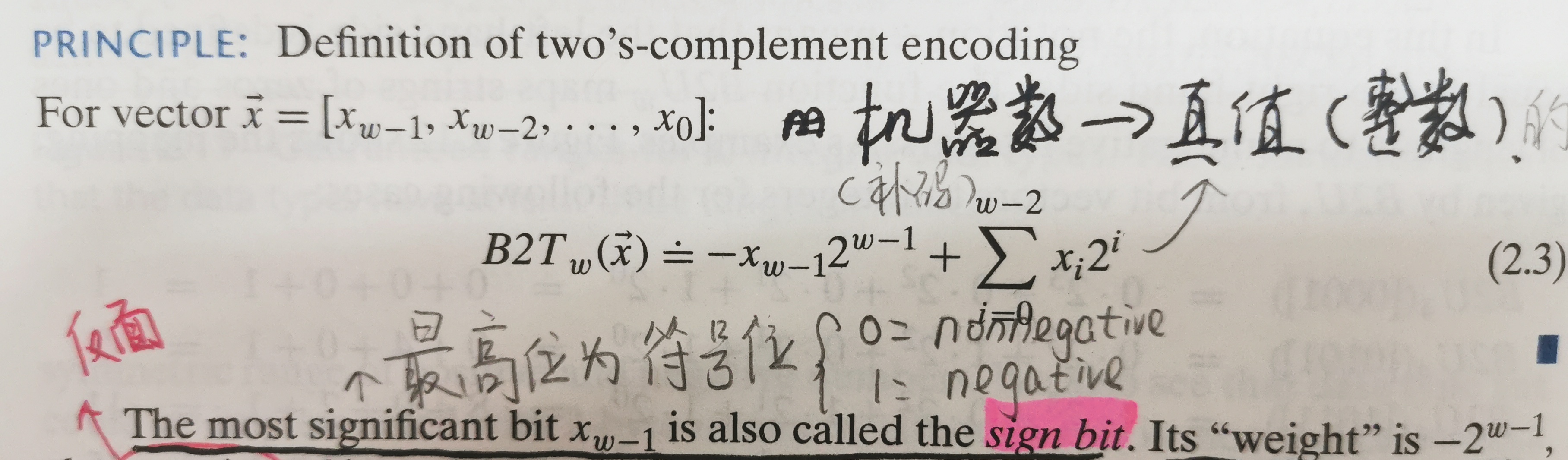
We can easily get some useful conclusions according to the picture above.
Example 1: 2³¹ = -2³¹
unsigned int a;
int b;

a = 2147483648;
b = (int)a;

printf("a = %u,  b = %d\n", a, b);
The output will be a = 2147483648, b = -2147483648.
Because that:
2147483648 is (1000 0000 0000 0000 0000 0000 0000 0000 0000 0000 0000 0000 0000 0000 0000 0000)₂, which turns into a signed integer will be (-1)*2³¹, whose decimal form is -2147483648.
Actually, in c, when you input -2³¹ to a int type variable i, then perform i = -i,
i is still equal to -2³¹.
Example 2: 2³² - 1 = -1
unsigned int a;
int b;

a = 4294967295;
b = (int)a;

printf("a = %u,  b = %d\n", a, b);
The output will be a = 4294967295, b = -1.
Because that:
4294967295 is (1111 1111 1111 1111 1111 1111 1111 1111 1111 1111 1111 1111 1111 1111 1111 1111)₂, which turns into a signed integer will be (-1)*2³¹ + 1*2³⁰ + ... + 1*2¹ + 1*2⁰, which is the largest negative integer, in other words, -1.
That's Amazing!